
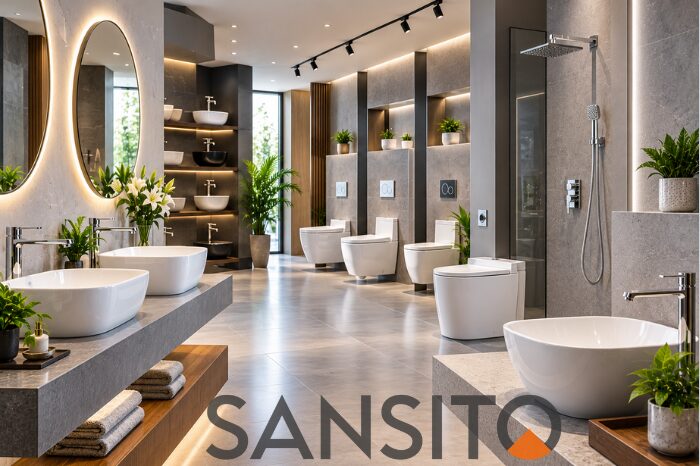
The Material Intelligence of a Sanitaryware Company in India
It’s easy to imagine that a bathroom is a plain, everyday space, but each surface, curve, and edge has been designed for tougher day-to-day use. Bathroom fixtures are subjected to pressure from water, cleaning chemicals, temperature shifts, stains and overuse. In India, the choice of materials for a modern sanitaryware manufacturer is not just a manufacturing decision. It is a sort of intelligence in design that sets the durability, hygiene, appearance and long-term user experience.
The ceramic was only the beginning
The word sanitaryware is not all it covers, but ceramic is the foundation of sanitaryware. The properties of the product which is to be made follow from the constituents of the raw materials, the size of the particles, the amount of moisture, the process of forming and the firing process.
Strength, porosity, dimensional stability and surface quality can be affected by small variations. That’s why material science is lurking in the background of many seemingly simple products that go into bathrooms.
The Science of Low Porosity
A material property that is significant to a bathroom fixture is the property of porosity. Moisture and contaminants may seep into the body of the ceramic product and cause hygiene and long-term problems if there is excessive porosity.
Modern manufacturing thus aims at obtaining a dense and stable ceramic structure. Controlled firing helps the material formed to become a higher-strength body and absorb less water, which leads to improved ease of maintenance and service life.
Glaze Creates the Visible Surface
The ceramic body gives shape and form, and the glaze gives users much of the experience. The smoothness, gloss, colour and stain resistance are closely linked to the quality and use of the glaze.
If the surface is developed correctly, dirt can be reduced, and it is easier to clean the surface on a regular basis. It also helps to create a visual uniformity that is demanded in modern bathrooms – where surface quality has become as significant as shape – by blending in with the rest of the bathroom. It also helps to achieve the uniformity in surface quality that is expected from contemporary bathrooms, where surface quality is very much in step with shape.
Thus, for an Indian sanitaryware manufacturer, glazing is not just a technical procedure, but also a design art.
Firing turns Chemistry into Performance
Material engineering turns into physical performance in the kiln. Raw components are subjected to complex changes, depending on carefully controlled temperatures, which make up the final characteristics of the ceramic body and glaze.
The result is affected by temperature uniformity, firing time and atmosphere. If a piece is under-fired, its strength, surface development and glazing properties may suffer; if it is over-fired or unevenly fired, it may be distorted or have other faults.
This level of accuracy, therefore, is crucial to ensuring a consistent product from sanitaryware in large volumes.
Shape Depends on Material Behaviour
Aesthetics are discussed in connection with the design of sanitaryware, such as soft curves, sharp edges, compact forms or minimalist silhouettes. However, each shape needs to withstand the production process.
Shrinkage or deformation can occur due to material behaviour during drying and firing. When moulds and dimensions are designed, it is crucial for designers and engineers to be aware of these changes.
This is not only geometry, but also the behaviour of the material, which is why, for example, a seemingly simple wash basin or water closet can have a lot of engineering going on behind the scenes.
Surfaces are turning smarter
Material innovation is also transforming how sanitaryware relates to the surroundings. Smoother surfaces, better glaze characteristics and manufacturing controls can help make cleaning easier and help resist the day-to-day abuse of a bathroom.
The goal is to be more and more to develop products which need less maintenance and look gorgeous over the years. In this context, material intelligence is closely related to the rise of functional, easy-to-clean design.
Water Shapes Material Decisions
Water efficiency has evolved into a key factor in sanitaryware engineering. Fixtures should operate water efficiently and provide the intended functionality.
This involves manufacturers going beyond the material and taking into account how ceramic geometry, internal flushing and waterways interact.
While a material can be a foundation, the actual performance of this foundation in the entire fixture is dependent on the design of the fixture.
Consistency Is an Engineering Achievement
Making one good ceramic fixture is one thing; making thousands of the same ceramic fixture with the same dimensions, finish and performance is another.
The control of raw materials, moulds, casting, drying, glazing and firing is all critical for industrial manufacturing. Each stage can have an impact on the end product. Consistency thus turns into a quantifiable manifestation of manufacturing maturity.
In the case of a sanitaryware company in India, ensuring this uniformity at a large scale is one of the lesser-talked-about but crucial elements of quality.
Material Intelligence Meets Interior Design
The bathroom (bathrooms) is no longer a blank slate. Fixtures have become more of a statement piece for the interior, as more and more architects and homeowners are looking for fixtures that help to define the interior.
This has taken sanitaryware materials and finishes into a new design realm. There is now a balance between proportion, texture, colour and surface reflectivity with structural performance.
When engineering and aesthetics complement each other, best results will be achieved.
The future is in better materials, not more materials
The new generation of sanitaryware does not necessarily have to feature ever more intricate products. It could be more intelligent application of materials – more intelligent formulations, tighter process controls, longer-lasting surfaces and more efficient use of resources.
This transition is part of a sweeping change in manufacturing. The intelligence is transitioning from the “what” of a product to its “how” of the material structure for its life.
Final Words
The intelligence of a sanitaryware company in India is really in the depth of the material. It exists in ceramic formulation, in the low porosity and in the development of the glaze, in firing accuracy, in dimension stability, in the material and water relation.
This seemingly humble bathroom accessory is actually the culmination of chemistry, engineering, design and manufacturing combined. With rising standards of hygiene, durability,aesthetics, and performance, material intelligence will continue to be one of the key drivers of the next generation of Indian sanitaryware.

0 comments