
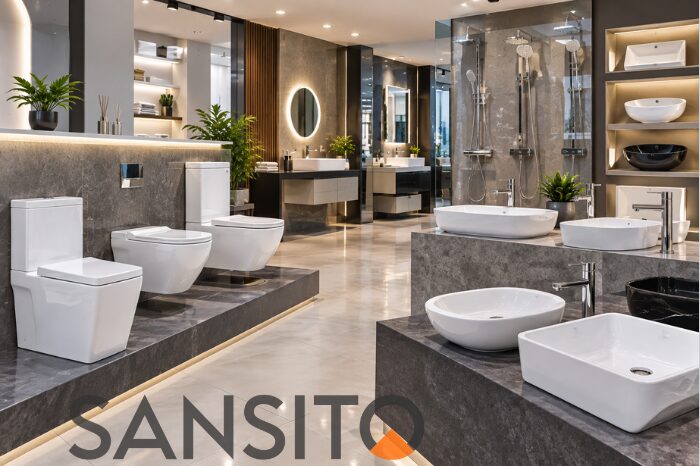
The New Visual Language Emerging in Sanitaryware India
Bathrooms were originally designed with the main purpose of functionality. They have become more of an indicator of a house’s persona in today’s world. The form, proportions, finish, colour, and even the quantity of visual space around a fixture now enter the design discussion. This transformation is ushering in a new visual language in sanitaryware in India, and bathroom products are no longer considered only as a necessity but as an integral part of interior architecture.
From Utility to Visual Identity
The traditional bathroom tended to be repetitive and was usually composed of a basin, a water closet, a shower, and a storage space, all chosen for their useful purposes. This is a new approach to the same elements in contemporary interiors.
The interaction of fixtures with walls, floor, lighting, and furniture is increasingly taken into account when designing. A wash basin can be a sculptural focal point, and a water closet mounted on the wall can help to visually reduce clutter. Sanitaryware is increasingly being used as an element of the room design, as opposed to a late addition.
Curves Are Rewriting the Silhouette
The most obvious shift is in the trend of softer shapes. Some of the more severe geometric forms often found in contemporary bathrooms are being replaced by rounded basins, curved edges, and flowing forms.
These curves have more than just an effect on the appearance. They can add soothing visual shifts and add a sense of rest in a space where ceramic tiles, stone, and glass are often the predominant materials.
The consequence is a bathroom that is not as technical as it could be, but feels more homey.
Minimalism Has Changed the Meaning of Simplicity
Minimalist design has swayed the world of sanitaryware in India from aesthetics to proportion and clarity.
Fixture size, edges, and proportions can be nicely resolved to create a strong visual presence in a simple fixture. Clean silhouettes also provide more visibility for the surrounding architectural materials.
That is why modern sanitaryware pieces are frequently simpler than big and fancy. The sophistication is in what’s been taken away.
Colour Is Moving Beyond White
Whites are the core color for a bathroom, and the range of colors has expanded to be more modern. Matte surfaces, softer neutrals, and darker hues are being introduced to design-conscious spaces now more than ever.
Colour can affect the way a fixture interacts with its environment. Contrast can be used with light tiles to create a deep finish, or muted tones will work within a minimalist setting.
This development is a part of a broader trend – sanitaryware is starting to become part of the room’s colour scheme, instead of just being a part of it.
Surfaces Have Become a Design Feature
As important as the shape of a sanitaryware product can be, so can the surface. A shiny surface will reflect light, giving a crisp and polished look, while a matte surface will add a more subdued visual effect.
The size or density is also influenced by texture and reflectivity. The same shape can convey many different moods with different lighting.
The surface development is thus gaining ground as a field of linkage between material engineering and interior design.
The rise of floating forms
The use of wall-mounted and suspended bathroom fittings has brought in a new design concept negative space.
If the floor plane of fixtures is visible, the space can feel more open and less dense. The floating effect also helps to create stronger horizontal lines and lets the flooring patterns continue uninterrupted.
This is an example of how a seemingly practical installation choice can impact the look of a bathroom.
Hospitality Is Influencing Homes
Hotels have always used the bathroom as a space for guests to enjoy rather than just a space to serve guests. That influence is becoming more and more pronounced in the interiors of residences.
People are choosing larger mirrors, matching hardware, and aesthetic and harmonious materials and finishes from the hotel industry. Not only is the bathroom a space for cleanliness, but it is also a space for comfort and personal life.
The sanitaryware, therefore, must be accommodated in a more sophisticated lifestyle environment.
Proportion Has Become a Quiet Differentiator
Almost the same function can be performed by two fixtures, but they look completely different, as they have different proportions.
Bowl depth, rim thickness, height, projection, and surrounding clearance relate to each other to govern the position of a fixture in a space. With compact bathrooms, even minor alterations can impact circulation and visual balance.
This is why proportion is becoming a more significant aspect of sanitaryware design. The best designs appear to be simple because their proportions have been precisely determined.
Technology Is Becoming Less Visible
The bathroom language is also evolving with modern innovations. Better flushing systems, water-saving features, and hidden plumbing and manufacturing accuracy enable more technology to be concealed.
Consumers are now demanding higher performance and not more visual complexity.
This leads to an interesting design concept: The more intelligent the product is, the less techy it can be.
The Consumer Is Designing Differently
This change in consumer expectations is driving a lot of this transformation along the way. Bathrooms are now taken pictures of, shared, remodeled, and discussed with the rest of the house.
This has led to more interest in coordinated collections and streamlined finishes and products.
Manufacturers are increasingly aware of the significance of consumer behaviour, alongside knowledge of ceramic materials and ceramic manufacture.
Indian Design Is Becoming More Diverse
There is no one clear trend in the future of sanitaryware in India. Modern Indian bathrooms feature a variety of designs, with some being designed as a simple urban room, while others are designed as a natural interior or extremely luxurious room.
This diversity is stimulating manufacturers to consider designing for more than one common language. Colour, form, scale and function vary from house to house.
The key is to make something flexible and yet not generic.
Final Words
The new visual language of sanitaryware in India is centered around a key shift, which is that bathroom fixtures are becoming design objects as much as they are functional products.
The modern bathroom is being redefined by curves, free forms, elegant proportions, innovative finishes, subtle colours, and hidden technology. Most significantly, they show a wider Indian interior trend: in which the objects of everyday use are thought to play a role in the emotional and visual character of the interior space.
So, the future of sanitaryware might well lie with designs that don’t just take up space in the bathroom, but help shape it.

0 comments