
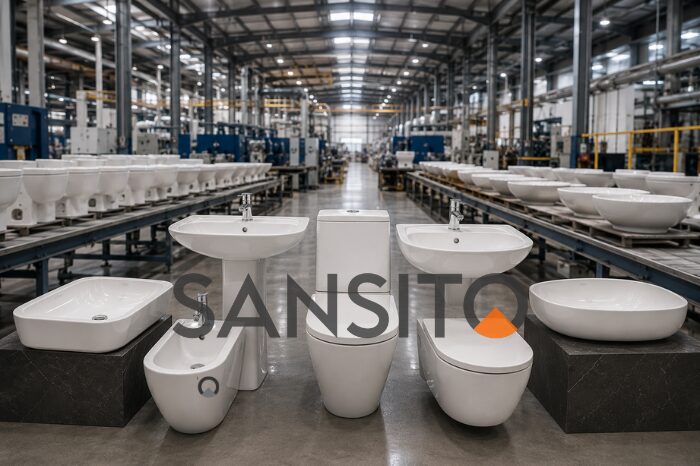
The Cluster Effect Behind Sanitaryware Manufacturers in Gujarat
No single factory can succeed in industry. It usually occurs when several manufacturers, suppliers, skilled workers, logistics companies, technology providers, and other businesses that support them in the same ecosystem are linked together in these networks. The Gujarat sanitaryware industry is a good example of such a phenomenon. The development of sanitaryware manufacturers in Gujarat is intricately linked to the cluster effect, which brings benefits beyond the factory floor.
A manufacturing cluster can facilitate the flow of knowledge, gain efficiency in the supply chain, facilitate specialisation and create an environment where businesses influence each other on an ongoing basis.
More Than a Collection of Factories
A real industrial grouping is more than just a collection of manufacturers. It is a system in which various businesses interact and work within the same value chain.
It could be raw material suppliers, mould experts, machine manufacturers, packaging companies, transport operators, finishing experts, and manufacturers. Every participant helps to carry out a part of the production process.
This web of relationships can make one region stronger than any individual company.
Specialization Brings About Efficiency
The manufacturing cluster brings about specialization in businesses. Some businesses might specialize in a specific part, some in machinery, and some in offering a specific service or materials.
This specialization of skills enables manufacturers to obtain the skills they need without building each one from scratch. As time passes, expert knowledge is focused in the area.
Such specialization can help in enhancing production flexibility and efficiency for sanitaryware manufacturers in Gujarat.
The skills are cascaded throughout the Ecosystem
One of the most crucial components of any industrial cluster is people. The more people are employed in the manufacturing industry, the more experience they gain in the industry. The more people are working in the manufacturing industry, the more experience they have in the industry.
Learning can be transferred across organisations through mobility, coming together for professional networking and resource sharing, with suppliers, and through industry experience.
This forms an informal network of knowledge which can enhance the capacity of the larger manufacturing arena.
Suppliers Become Part of the Competitive Advantage
Without reliable inputs, a manufacturer cannot function effectively. Production performance is affected by raw materials, parts of machinery, packaging, transportation, maintenance services, and technical support.
Communication and coordination can be facilitated when these supporting businesses are part of or adjacent to a manufacturing cluster. The shorter the supply chains, the more responsive they will be if there is a change in production requirements.
Therefore, the power of manufacturers is partially related to the power of their encompassing supplier network.
Competition can stimulate innovation
Clusters provide a balance between cooperation and competition. Companies can rely on the same equipment and vendors and be rivaling each other for customers and market share all the same.
The competition may be a catalyst for manufacturers to advance processes, invent new products, invest in technology, and enhance quality.
If there are several players in the same ecosystem, their changes can have a ripple effect throughout the industry.
The Cluster is connected to the infrastructure
The creation of a manufacturing cluster involves more than skilled people and suppliers. Roads, logistics, industrial utilities, communications, and market access have an impact on the ability to run businesses effectively.
An efficient connection enables the transportation of the raw materials to the factories and the finished products to the domestic and international customers.
Infrastructure is thus the physical structure that is a supporting entity to the industrial ecosystem.
Clusters form a Growth Cycle
Well-developed clusters can establish a positive feedback loop that promotes their growth. Manufacturing activity brings suppliers. Suppliers develop particular jobs. Attract more businesses and skilled people. Rising production leads to investments in technology and infrastructure.
As the ecosystem grows, it can become more appealing to new manufacturers and supporting industries.
This is not only a vicious circle, but is also a vicious circle.
The Future of Gujarat’s Manufacturing Clusters
The next level of industrial concentration will probably be more digital and closer together. Other elements of regional ecosystems could be further enhanced by shared technology networks, data-driven production, advanced logistics, renewable energy systems and automated manufacturing.
The future of sanitaryware manufacturers from Gujarat may therefore be dependent not only on the performance of individual sanitaryware manufacturing units but also on the performance of the manufacturing network in general.
Final Words
Individual sanitaryware manufacturing units are not the only factors that can be considered for the success of the sanitaryware manufacturers in the state of Gujarat. It’s also the story of joined-up businesses, specialist skills, complementary infrastructure, supply chains, and competition.
The cluster effect establishes a context where knowledge, resources and capabilities flow around the region. This interdependent ecosystem may continue to be one of Gujarat’s biggest strengths in its sanitaryware industry, as technology and manufacturing evolve.

0 comments