
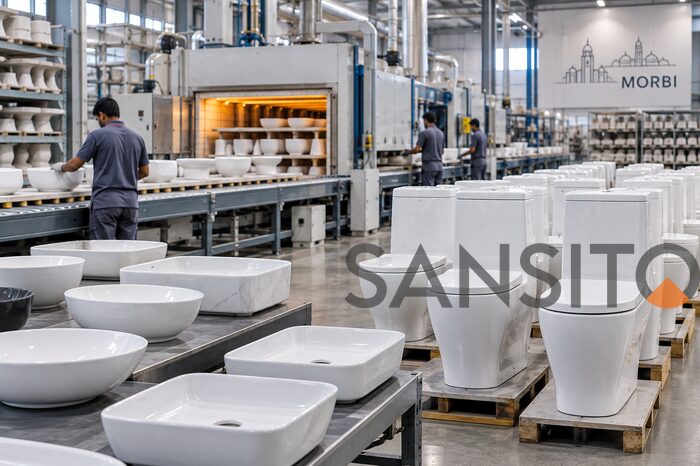
The Ceramic Heritage of a Sanitaryware Manufacturer in Morbi
A modern bathroom fixture could be of a contemporary design, but its material history goes back to an ancient ceramic-making tradition. The term sanitaryware manufacturer in Morbi is not geographically limited, but is strongly linked with the production of ceramics in Morbi. It illustrates a manufacturing culture based on raw materials, kiln technology, craftsmanship, process control and adaptation. This legacy combines with today’s design to create modern sanitaryware.
Ceramic Heritage Begins With Material
The first step in any sanitaryware product is the preparation of the material. Clay, minerals and other ceramic materials need to be prepared into a body that can be processed into a uniform shape, dried, and fired. They have properties that affect strength, density, shrinkage and surface properties.
Knowing the material is the basis for a sanitaryware manufacturer in Morbi. Heritage isn’t just the old craft; it’s about the behaviour of the materials, and how to use that understanding to achieve repeatable industrial performance.
The Kiln Is the Turning Point
There are few processes in ceramics as significant as firing. The physical and chemical transformations that take place in a shaped ceramic body inside the kiln will affect many of the final properties.
Dimensional stability, strength and glaze development may be affected by temperature, heating rates, atmosphere and firing time. Though the technology of the modern kiln has advanced to improve control, the basic principles of precise transformation control for creating ceramic quality are still understood.
It’s the harmony of traditional ceramic know-how and industrial discipline.
From Craft to Repeatability
In traditional ceramic making, the individual variation could be a part of the object’s identity. When it comes to industrial sanitaryware, there is a different goal to aim for—consistency.
The dimensions of a basin, toilet or pedestal are set and must be repeated for each use. Manufacturing teams thus operate with moulds, controlled forming processes, drying schedules, glazing systems and inspection procedures.
The change from craft variation to engineered repeatability is the industry’s evolution for Morbi’s sanitaryware manufacturer.
Glaze Creates the Visible Identity
The ceramic body provides structure, and the glaze dictates a large portion of the surface that consumers see. The characteristics of colour, gloss, smoothness and uniformity are related to the formulation, application and firing of glaze.
The key to a successful glaze is that it needs to look good in addition to other things. It shall adhere to the ceramic body and operate normally under normal conditions in the bathroom, such as wetness and regular cleaning.
The final look will then be linked to design choices that are not apparent to the naked eye at installation.
Geometry Is Part of Ceramic Engineering
The bathroom has become curved, has made the transition to a skinny design, wall mounted and has become minimalist. Creating these shapes in ceramic takes more than a painter’s imagination.
During the firing and drying processes, ceramic bodies will shrink and may even deform, which means designers and engineers need to consider these changes in dimensions. These changes must be taken into consideration when designing a mould prior to production.
Ceramic manufacture is a craft and an engineering discipline, in part due to the link between geometry and material behaviour.
Morbi’s Industrial Transformation
Morbi’s ceramic identity has grown as production capability, technology and market linkage have grown. This initially ceramic-related identity has expanded to become an industrial system of production, machinery, logistics, materials, and services.
This ecosystem can offer additional capabilities and industrial expertise to sanitaryware makers. Not just factories, but the web of materials, manufacturing and finished products.
Technology Extends the Tradition
Manufacturing does not have to be the same to be heritage. Automated equipment, process monitoring and inspection systems and digital modelling are assisting ceramic manufacturers to enhance precision.
Using 3D design can be a way to perfect intricate forms prior to mould production. Repeatability can be aided by automated systems. Inspection technologies are able to detect dimensional or surface variation.
The tools enhance ceramic understanding by providing more control and measurement of ceramic production.
Sustainability Adds a New Requirement
Modern ceramic production also has issues of resource utilisation. The use of energy during firing, material waste, water use and packaging can impact the environmental footprint of a product.
Manufacturers can better utilise resources through improved kiln efficiency, improved process control and reduced rejections. The durability of a product is important because sanitaryware that is durable will reduce the need to replace it.
The next step is to be responsible in the use of knowledge while preserving it.
Design Connects Industry With Home
Sanitaryware’s final destination is no longer just a functional space. Colours, shapes, proportions and finishes are increasingly coming to play a role in the design of bathrooms, as part of the interior design.
This puts a higher strain on manufacturers. Products should meet technical criteria, but be appropriate to modern taste.
The understanding of material behaviour and the evolving culture of design is imperative for a manufacturer with ceramic roots.
Final Words
The ceramic tradition of a sanitaryware company in Morbi can be best understood by considering it as a dynamic process of interaction between knowledge about the materials and innovations in the industry. Digital design, automation, inspection and process control are added to clay, moulds, glaze and kilns, which continue to be the core of the production process.
The “foundation” is there, and technology is changing the way it’s expressed. The outcome is nothing but a blend between craftsmanship and modern manufacturing. It’s the conduit where they get mixed together.
This integration puts an old material into new forms, new technologies and new roles in the modern bathroom, which makes Morbi’s sanitaryware world so special: an old material which continues to develop in new ways, new technologies and new functions in the modern bathroom.

0 comments