
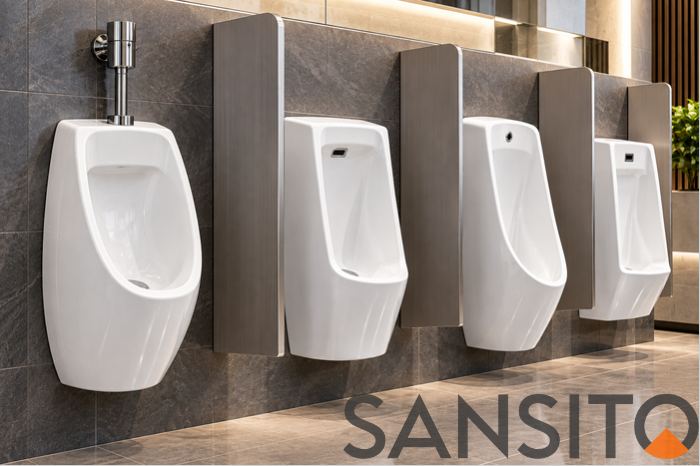
The Flush Equation of a Urinal Manufacturer
Although the urinal may seem like a self-evident piece of equipment, it depends on the relationship between water, ceramic geometry, drainage, and hygiene. For a urinal manufacturer, making a functional urinal isn’t enough. It is creating a system that ensures water gets to the appropriate surface areas, drains away well, reduces splashing, and conserves resources.
Water Is Part of the Architecture
The urinal is a machine that is geared toward motion. Water is introduced, flows over specified surfaces, enters the bowl, and flows into the outlet. Geometry is a fundamental part of every stage.
The inlet position, the angle of the ceramic surface, and the shape of the outlet may affect the performance. One small modification in something can impact the behavior of the fixture.
The Bowl Shapes the Flow
The water flow through the urinal is dictated by the urinal’s ceramic form. Curves and slopes must funnel water to the drain, but not cause extra pooled water.
This engineering can be concealed using good design in a simple form. Naturally flowing water makes the fixture easier to use and maintain.
This is the place where the industrial design and fluid engineering converge.
Splash Control Starts With Design
Commercial washrooms are used regularly and need to be kept clean and maintained, and managing splashes is important for this.
Manufacturers can counter splashing by varying the proportion of the bowls, positioning the inlets, and water distribution. The relationship between incoming water and ceramic surface should be considered.
A well-designed fixture, therefore, looks at what happens when the water first enters the bowl, NOT at what happens at the outlet.
Flush Volume Needs Balance
The more water, the better flush is not always true. The amount of available water is insufficient to cause its lack of distribution to be a problem for performance.
Flush volume, flow rate, surface coverage, and drainage must all be taken into account by a urinal manufacturer. The goal is to get the job done right while avoiding waste.
Water efficiency thus becomes a design element of the hydraulic system, instead of a separate environmental component.
Drainage Completes the Cycle
It is not complete until water and waste flow out of the fixture efficiently! This stage is affected by outlet dimensions, location of the drain, and the slope of the bowl.
Standing water or leftover water can result from poor drainage, which will lead to higher cleaning demands. Good drainage means that the material stays in the fixture for a shorter period of time and helps to maintain or facilitate a cleaner environment.
Surface Quality Supports Hygiene
The surface of ceramic is tough and can be used in the bathroom, and the smoothness of the glaze can be enhanced, and the visual effect can be made more uniform.
A well-developed surface makes normal cleaning easier and prevents residue from sticking to the surface. Thus, the interaction between material, surface, and geometry is of vital importance for hygiene.
Touchless Technology Adds Another Layer
In commercial applications, the flushing systems are controlled by sensors. It minimises physical contact and can automatically trigger flushing after use.
This requires that the ceramic fixture, sensor, flushing mechanism, and water supply function as a single integrated system. While technology can enhance convenience, reliable performance requires good hydraulic design.
Real Conditions Matter
The quality and frequency of use, and the cleaning procedures, are not the same at every site. Outlets and mechanisms may be impacted by mineral deposits, and durability is increased in high-traffic facilities.
When designing for actual conditions, manufacturers can make practical fixtures.
Precision Makes Performance Repeatable
The flushing concept has to be accurately reproduced in the manufacturing process. The size of the bowls, the position of the inlets, the design of the drainage openings, and the ceramic profile must be managed accordingly.
The drying and firing processes may have an effect on ceramic size, which is essential for ceramic consistency in production. Finished products are checked for geometry using inspection.
Precision translates a theoretical flow pattern into repeatable performance.
Public Spaces Multiply Small Differences
The urinals are used in offices, restaurants, hospitals, schools, transport facilities, etc., and in places where there is considerable activity. Minimal gains in water usage or maintenance can make a big impact when repeated many times per day.
The reliability, in turn, is thus a component of the building operations.
The Fixture Is Part of a Larger System
A urinal is connected to water supply and flushing controls, and has maintenance schedules. The performance of this depends in part on how it is installed and whether it is compatible with the system.
Manufacturers should take into account the mounting, service access, and connection needs along with the design of the ceramic. The complete installation determines the user’s experience.
Sustainability Enters the Equation
Commercial bathrooms are growing in importance regarding responsible water use. Optimizing flushing can save water while maintaining cleaning performance, and can be achieved with a hydraulic design.
Durability also matters. A long-lasting fixture reduces the material and manufacturing resources that are consumed, and the need to replace it frequently.
Final Words
The production equation of a urinal manufacturer is based on interdependent factors – water volume, distribution, ceramic geometry, splash control, drainage, surface quality, manufacturing, and technology precision.
This seemingly simple ceramic fitting actually represents a fully integrated hydraulic system. It is only effective when it moves water, manages residue, and produces consistent performance after repeated use.
After installation, the very best engineering is virtually invisible. Users just assume that the fixture will flush, drain, and be controlled. To bring that simplicity, a lot of decisions have to be made long before the product gets to the bathroom.

0 comments